Monday, June 21, 2010

Why I Support Mike Lee

Many of you have asked us about Mike Lee, and why we have been volunteering to help with his campaign.

We first heard Mike Lee speak back in January. He gave a two hour speech on the constitution, and then answered questions for at least another hour. We were so impressed with his knowledge and his love of the constitution. Even more than his speech, what impressed us was the way he answered questions. He was so respectful of the people asking the questions, and he always had very good and honest answer. It was after that speech that we first volunteered to help with Mike’s campaign here in Cache Valley.

We have had the opportunity to meet with Mike several times since, and have become even more convinced that he is the right man for the job. He WILL be an effective leader in the Senate.

Much has been said about the choice between a businessman and an attorney. While it is important to know what these two men have chosen as their profession, we believe it is more important to know what they have used their chosen profession to accomplish, as this may give us insight into the positions they will take as our Senator.

Tim Bridgewater co-founded Interlink Capital Strategies which is a consulting firm that helps businesses secure US federal grants and loans. Recently Interlink helped secure $10 Million in IPOC loans to help build affordable housing in Mexico (i-caps.com/ICS/Services.html). While this is a perfectly legitimate business venture, do we really want to be sending more tax money out of the country?

Mike Lee is an Attorney who has a proven track record of standing up to the government and defending the rights of the people. He fought the Obama administration in reopening 77 oil and gas leases in the Uintah Basin. He fought the ACLU in its efforts to have access to the Main Street Plaza in Salt Lake City. He fought for Kane County’s rights to maintain access trails on federal ground. Right now we need someone to represent us who has a proven track record of standing up to the government and defending the rights of the people, Mike Is that man.

With regards to Mike's involvement with Energy Solutions here's the truth:

While serving as Governor Huntsman's general counsel, Mike Lee lead the fight to keep nuclear waste (that is, spent nuclear fuel) out of Utah. That fight proved successful in 2006. Several years later, Mike's law firm was retained by EnergySolutions to represent that company in one case -- and one case only -- because of Mike's expertise in constitutional law. That case had nothing to do with spent nuclear fuel. Nor did it have anything to do with whether it is a good idea to dispose of Class A material, whether foreign or domestic, in Utah. Rather, that case dealt with whether the authority to restrict the importation of Class A material resides with (a) the States, or (b) the federal government. The federal district court agreed with Mike's argument that the Constitution leaves such import decisions in the hands of the federal government. Mike does not believe that Utah should be he world's dumping ground, and would support federal legislation establishing a categorical ban on the importation of Class A material. Mike also continues to oppose any plan to dispose of nuclear waste in Utah. Mike knows first hand the consequences of exposure to this harmful material. In 1996, Mike's father Rex Lee died from a form of downwinders syndrome. This tragic loss for the Lee family has made Mike an advocate against any harmful waste material. Mike's willingness to be a champion of the Constitution -- even where it might not be popular -- is demonstrated by his expert handling of these complex issues.

We hope you will join us, tomorrow, June 22 in voting for Mike Lee to be Utah's next Senator.

Thank You,

Garrick and Holly Hall


P.S. please feel free to call if you have any questions about Mike that we might answer for you. 435-232-1117

Sunday, March 7, 2010

Visit to Schreiber Foods

I had the opportunity to visit Schreiber Foods in Smithfield, Utah this past week and take a tour of the plant. Following the tour, a group of about 25-30 dairymen met with the plant manager to discuss their company and the potential to sell milk to them. I have driven by this plant many times, but I have not had the chance to go inside since I was just a young boy, and the plant was owned by Cache Valley Dairy. The plant has been expanded and remodeled several time since then. Schreiber has been leasing the plant for about three years now and is currently in the process of buying it.

I have had the chance to tour several cheese plants, but I was particularly impressed with this one. I noticed right away that the people who work there are referred to as partners, not employees. This is because Schreiber is employee owned, so they are all literally partners in the business. Everyone in the plant was very friendly and helpful, even though we were in their way. I was told there are about 450 people that work in the plant. They make several different kinds of cheese, mostly Swiss and American (cheddar, mozzarella). However, the largest part of the plant is the cutting and wrapping department. Much of the cheese they package is purchased in 40 lb blocks or barrels from other cheese plants in the region. They package cheese for many major retail stores, including Sam's Club, Costco, and Western Family to name just a few. They also provide cheese to such places as McDonalds, Taco Bell, and The Olive Garden. Cheese packaged in this plant is shipped all over the western US.

I was very impressed with the efficiency and professionalism that I saw on my tour. Schreiber is very important to our county, not only do they have the cheese plant in Smithfield, but they also have a plant in Logan. Schreiber provides many good jobs as well as very tasty, high quality cheese for all of us to enjoy. I was struck by the thought that as important as Schreiber is to our community, they could not exist without the dairies that produce the milk they need to make cheese. Businesses like Schreiber are the reason a recent Utah State study found that 15% of the economy of Utah is based on agriculture, while less than 2% of the public live on farms.

After my visit I made the decision to begin selling the milk from my dairy to Schreiber Foods.

Saturday, March 6, 2010

Nightline Response

I recently watched a report by Brian Ross on ABC’s Nightline. The report was about where milk really comes from, and featured video footage from an “Undercover Investigator” at a large “Factory Farm” in New York. As a dairyman watching this report I quickly realized that this was not an investigative report as had been advertized but was simply a propaganda piece by radical Animal rights groups(Mercy for Animals and HSUS). The video of the cows that was shown was not taken by ABC, rather it was shot by the “Undercover Investigator” who certainly had his agenda to prove. I began wondering if some of the clips were staged to enhance the shock value. For instance, I know of no one who docks tails in the manner shown in the report, all the dairies that I know use rubber bands that cut off circulation and then the tail just falls off after a few days. There seems to be very little pain and no blood involved with this method. (Not very shocking).

While I immediately saw this report for what it truly is, I realized that people unfamiliar with modern dairies would likely believe the fallacy of the report and believe that cows are abused and mistreated by dairy farmers, this could not be farther from the truth. In an attempt to counter the claims in the Nightline report I will attempt to compare cows to people, only because the term “Humane” is used so frequently to describe the way farm animals should be treated, although they are not human and should not be confused as such.

The cows in the report were shown standing in a crowded holding pen with no room to move, the assumption was made that cows are kept in this condition all day, every day, when in reality those cows were there only for a few minutes while waiting for their turn to go into the barn to be milked. This is much like stepping into a crowded elevator or crowded subway car, we would not want to be there all day, but we tolerate it long enough to get where we are going. After being milked all the cows returned to their pen where they have access to fresh feed, water and a dry comfortable stall to lay down in(not shown in the report).

During stormy weather people like to be inside where it is warm and dry, these cows have a warm dry barn to protect them from stormy weather. Likewise, when it is hot outside people like to stay inside an air-conditioned building, these cows have a shaded barn with fans and misters to keep them cool and comfortable.

These cows have their home cleaned at least once, probably twice a day. I know the report shows cows in several inches a manure, however since no reasonable explanation was given, I will assume that the corrals were in the process of being cleaned, the manure had been pushed to one end of the coral but had not yet been pushed all the way out of the coral (video footage being taken out of context for shock value). Some cows seek out dirty spots to lie in and seem to be able to find one regardless of the care taken to prevent it. We all know people whose personal hygiene is less than perfect; these people are the exception not the rule.

These cows have their beds made for them at least daily (raked out with clean fresh bedding applied as needed).

Every day these cows are fed a diet that is specially formulated to meet their nutritional requirements. This diet is formulated by a trained professional dairy nutritionist in order to provide the best health and comfort to the cow. These cows are also provided with all the fresh clean water they can drink (water being the beverage of choice for cows).
I hope you are beginning to see that these cows may be treated more “Humanely” than a lot of people. They are also provided with a pedicurist (Hoof trimmer) and a doctor (Veterinarian) when ever needed without having to worry about paying the bill.

There seems to be much concern about the pain involved with certain management practices such as dehorning. While there is some pain involved with dehorning the animals are better off without their horns. People undergo medical procedures that are painful knowing that it is for their own good. Who enjoys having their wisdom teeth pulled, it is painful and can cause discomfort for several days, yet we still pull wisdom teeth. Similarly we must dehorn calves for their own good. Dehorning methods have improved greatly over the years, we used to take a saw and cut the horns off (talk about a bloody mess). Today we simply burn them for a few seconds while the horns are still very small.

I know of no one who docks tails in the manner shown in the report, all the dairies that I know use rubber bands that cut of circulation and then the tail just falls off after a few days. There seems to be very little pain and no blood involved with this method.

The report concludes with an attack on the ethics of America’s dairy farmers. I would say the ethics are with the people who get up early every morning 365 days of the years (weekends and holidays included) to place the care and well being of their cows above their own comfort and often that of their family. America’s dairy farmers take pride in caring for our animals and producing a safe wholesome product for you and your family. In the future if people have questions about farming don’t ask ABC –ask a farmer. For more information on animal care go to www.conversationsonanimalcare.org.

Monday, November 9, 2009

Where did the fence post go?

Great article by Utah YF&R committee members Jason and Melinda Goble


The days of fencepost conversations are nearly a thing of the past. It is almost impossible to see farmers/neighbors leaning on a fence post, discussing the current issues in agriculture and the world as a whole. In today’s society, technology has taken over the way we communicate with
even our next door neighbor. Cell phones, computers, GPS systems, and iPods are just a few of the new devices commonly seen near or on the farm.

Facebook, blogs, twitter, and messengers are just a few of the ways people communicate with these new technologies. PETA and many other organizations are very familiar with all of these technological advances and are using them to get their word out and falsely inform people about
the practices of agriculture.

While attending a state Farm Bureau women’s conference, Melinda was awakened to the steps that other organizations are taking to accuse ag producers of malnourishing, mistreating, and endangering the animals in their operations. Through ways such as YouTube videos they are misinforming the public on all of our practices. This takes a heavy toll on the image of the farmer/rancher, and thus impacts the sale of our product. It is amazing how little the majority of the U.S. population knows about where their food comes from and how it is brought to their grocer.

The youth of today are very familiar with all of this new technology, but often even more naïve about the food they eat. In the classes Jason teaches, students are required to use the internet regularly, for research and learning. He has assigned students to research various agriculture topics and take a stand on issues affecting agriculture. Students can find both positive and negative views of agriculture with just the click of a button. Videos such as, “The Meatrix” can confuse students as well as adults who may see them. If not explained the actual practices used on our farms and ranches, people just assume that the “truths” given to them from other sources are correct. This leaves them with an inaccurate perception of the way agricultural practices occur.

As agriculture producers and enthusiasts, we have a responsibility to occasionally leave the fence posts and learn these new technologies. We need to take it upon ourselves to promote our own operations, giving people a new and accurate insight to what really happens on our operations.
This will help students and the public in general to see the correct view of our agriculture practices and get rid of the negative image that has been placed on us by outside organizations.

Friday, October 16, 2009

New York Times attackes the Farm Bureau

Farm Bureau Aims to Kill Climate Bill
By Kate Galbraith
American Farm Bureau The American Farm Bureau, a large agricultural lobby, is gearing up a campaign to defeat climate legislation now pending in Congress.
The politically influential American Farm Bureau, the self-described “national voice of agriculture,” has outlined a new campaign effort to derail Congressional bills to combat climate change.
In a memo obtained Wednesday by Green Inc. and addressed to state farm bureau directors, the group’s public-relations director, Don Lipton, wrote:
Climate change bills in both the Senate and House will impact our farmers and ranchers, hit America’s consumers and impair the economy of our nation. For farmers and ranchers, it will mean higher fuel and fertilizer costs, which puts us at a competitive disadvantage in international markets with other countries that do not have similar carbon emission restrictions. For the future prosperity of the U.S. economy and American agriculture, climate change legislation must be defeated by Congress.
The authenticity of the memo was confirmed by Cody Lyon, the American Farm Bureau Federation’s director of grassroots and political advocacy.
The campaign’s slogan will be “Don’t CAP Our Future” — a play on the baseball-style caps often worn by farmers. According to the memo, state farm bureaus will get a campaign “starter kit” — including themed stickers — by early next month.
The memo urges members to place a “Don’t CAP Our Future” sticker on a farmer’s cap, sign either the sticker or the cap, and hand-deliver it to a local office of the United States Senate.
“The timing is very beneficial as many state Farm Bureau annual meetings are right around the corner,” the memo says.
Other suggested tactics include: sending messages to Senate offices; an online petition; a large banner and booths at the annual state farm bureau meetings; passing a resolution against the climate bills at state meetings; and writing opinion articles for local papers.
The American Farm Bureau’s position puts it at odds with the Secretary of Agriculture, Tom Vilsack, who has argued that the costs of cap-and-trade to farmers will be outweighed by the benefits — from carbon offset revenues, for example.
The farm bureau has also recently campaigned against the possibility of a “cow tax” on methane emissions, which the Environmental Protection Agency has not proposed to do.

Cap and trade will harm all farms, not just the so called 'factory farms". As the owner of a small family dairy farm I understand that the current cap and trade legislation would most likely force my family out of business. If we run farms out of the US, the millions of people who depend on American farmers for food, will be forced to get food grown in other countries, countries that do not meet the rigorous environmental standards we as American farmers meet. The end result will be to increase, not decrease the "carbon footprint" of the food we eat.

I applaud the Farm Bureau for standing up and fighting for all US farms. Cap and trade is not only bad for farmers, it is bad for our environment and bad for America.

Thursday, October 15, 2009

Life On our Farm

This is a video I put together for my PAL class introduction. It shows a glimpse of what our family does on a daily basis to care for our calves and cows.

Tuesday, October 6, 2009

Cap and Trade

The following is a presentation I used as my platform for the first PAL modual in New York City Sept. 14-17,2009.

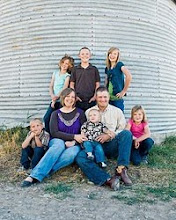
I’m Garrick Hall, my wife and I and our five children own and operate a small dairy in northern Utah. We take pride in caring for our animals and producing high quality milk. Supporting a family on a small farm is not easy but we manage. I want to take a minute to tell you how proposed new legislation would affect my family’s dairy farm and others like us.

The Waxman-Markey cap and trade bill, currently under consideration in the US Senate, is simply a tax on energy. It takes a lot of energy to run our dairy farm. It takes a lot of electricity to run the motors used to milk the cows and cool the milk. We use a lot of diesel to run the tractors used to feed and care for the animals. It gets very cold in the winter where we live so we use natural gas to heat the barn and keep things from freezing up. We have to pay freight costs to bring feed into the dairy and to haul milk out of the dairy. All these costs would increase significantly if cap and trade is implemented.

Using numbers from the Heritage Foundation, if Cap and Trade had been fully implemented in 2008, it would have cost my family over $23,000 in increased energy costs. Roughly the cost of a brand new car for my family.

My fear is that I will be left to pay these increased expenses, with little if any increased revenue. Because these expenses will only be charged to US producers, they will not have a significant effect on Climate Change; however they will put American farmers and ranchers at a disadvantage in a global market. If we increase cost to Farmers here in America without requiring the same from farmers in other countries, farm production will be driven out of the United States and food will be imported into the US. If we are truly concerned about our “carbon footprint” this should be very concerning. Farmers in many of the countries that will most likely replace the American farmer do not have to comply with the strict environmental regulations we impose here in the US. Simply put US farmers can produce more pounds of food per pound of carbon emission than farmers in most foreign countries. Forcing food production out of the US would in the end have a negative effect on carbon emissions, or increase the “carbon footprint” of the food we eat.

The bottom line is that Cap and Trade would most likely force my family along with many other livestock farmers out of business. Much of rural America is dependent on these livestock farms. From the purchasing of feed, supplies, labor, equipment, and much more, along with processing, hauling, and marketing of the products we produce. There are a tremendous number of jobs and people depending on the livestock industry. The result of Cap and Trade would be to run livestock farmers (such as myself) out of business and devastate the rural communities we support, while failing to significantly affect Climate Change.